Depots that store and dispense diesel, petrol, biofuels or heating oil must comply with the 2002 DSEAR (Dangerous Substances & Explosive Atmospheres Regulations).
In the past, explosive atmospheres in depot refuelling facilities were mainly associated with a risk relating to petroleum spirit. However, under the 2008 EU CLP Regulation (European legislation on Classification, Labelling and Packaging of hazardous chemicals), several substances now meet the criteria for classification as flammable which did not do so in the past.
The change means that, for example, gas oil and light heating oils are classified as flammable liquids. This does not mean that these products are more dangerous than they were prior to the classification, but insurers may expect you to risk assess them as flammable.
Fuel refuelling and storage areas can be defined as:
A place in which an explosive atmosphere consisting of a mixture with air of dangerous substances in the form of gas, vapour or mist is not likely to occur in normal operation but, if it does occur, it will persist for a short period only.
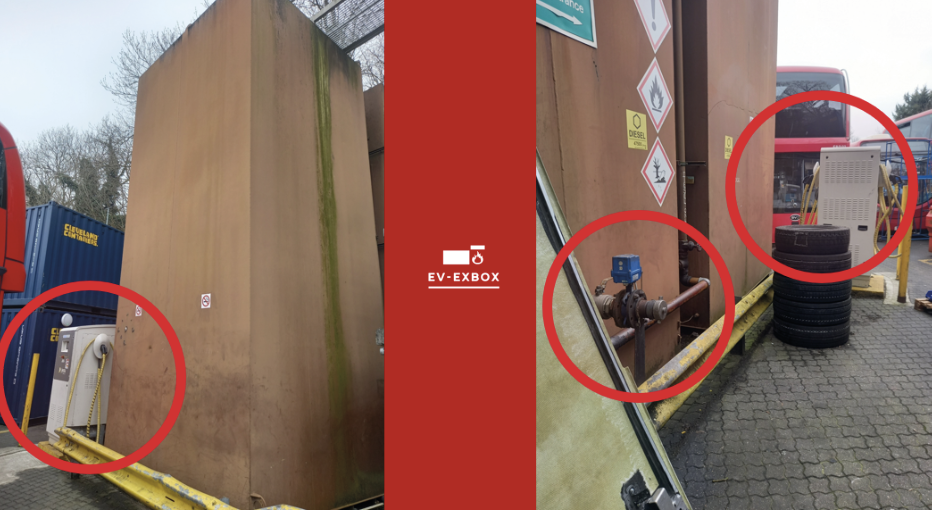
From a risk assessment perspective, a depot should not have electrical equipment that is not intrinsically safe within these zone extensions from the tanks and refuelling infrastructure.
This principle applies not only to EV chargers but also to feeder pillars, substations, power cabinets and even the charging connection point on the vehicle.
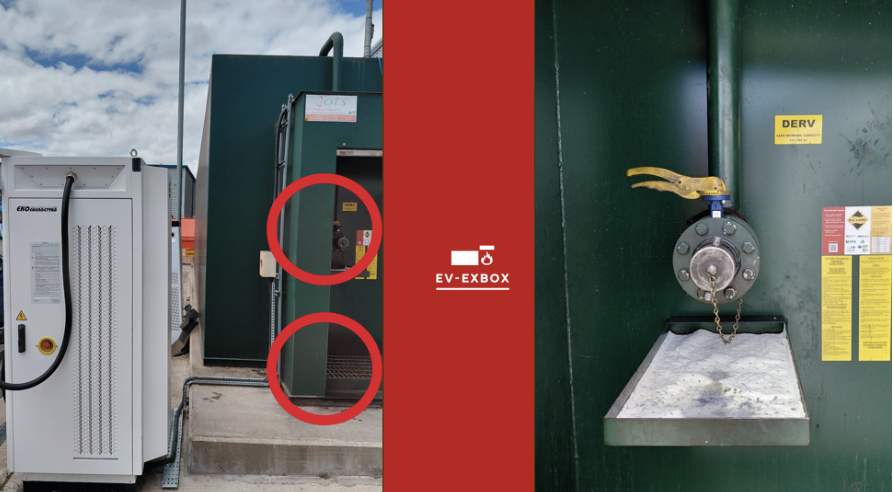
When the EV-EXBOX team talk to EV charging infrastructure installers, we realise that an understanding of DSEAR and ATEX zones is not always part of their core skill set, and we see non-ATEX equipment often creeping into hazardous areas.
The confusion often comes from the fact that DSEAR is a goal-based regulation. It tells you what outcomes you must achieve, but not the exact distances, layouts or engineering solutions you must use.
DSEAR therefore does not tell you:
- “EV chargers must be X metres from diesel tanks.”
- “Vent pipes must be Y metres from electrical equipment.”
- “Zone 2 extends exactly Z metres.”
For this information, you must look to technical standards and competent engineering judgement, which should consider the following areas:
- Tanker delivery areas – During deliveries, hazardous zones expand significantly. Vapours can accumulate around the tanker stand area, hose connections and fill points.
- Above- and below-ground fuel storage tanks – These create permanent ATEX zones around vents and tank tops.
- Fuel separators and interceptors – These create permanent ATEX zones around vents.
- Chambers and access lids to below-ground fuel infrastructure – These can release vapours when lids are removed. Vapour-tight lids can be safe if they are well maintained and regularly inspected, but they create an ATEX zone when removed.
- Vehicle refuelling areas – The reach of a fully extended fuel hose towards an EV charger or associated charging infrastructure is a critical determinant of safe placement. Likewise, the reach of a fully extended EV charging cable towards an ATEX zone is a critical determinant of safe placement.
Understanding these risks is the foundation of any competent installation strategy. DSEAR tells you what outcomes you must achieve, and industry guidance tells you the numbers.
For fuel storage infrastructure—including tanks, dispensing equipment, tanker deliveries, vent pipes and separators—the best sources of technical guidance can be found in the following publications:
- APEA Blue Book – Guidance for Design, Construction, Modification, Maintenance and Decommissioning of Filling Stations (Blue Book 5th Edition)
- Energy Institute – Guide to Electric Vehicle Charging Installations at Filling Stations, 2nd Edition
- BS EN 60079 series (ATEX zoning)
A further consideration that can be overlooked by depot operators is: in the rare event that an EV fire occurs, is the EV charging location readily accessible to fire and rescue services?
This is important, as fire spread between electric vehicles and between electric vehicles and other flammable and combustible materials can be exceptionally fast. Whereas historically fire spread between diesel vehicles may take in the region of 10–15 minutes, vehicle-to-vehicle fire spread where jetting from an EV battery pack occurs can take less than two minutes.
Anything that prevents the fire and rescue services from being able to tackle the fire easily typically means more vehicles or wider fire spread on site will occur. This may present a significant risk to business continuity.
In the event that something goes wrong with regard to EV charging infrastructure, a competent risk assessment may be the first thing you are asked to provide in any ensuing investigation—especially by your insurers.
EV Charging: Liability, Negligence and Insurance Exposure
When the EV-EXBOX team discussed the implications of not having a competent risk assessment in relation to the installation of EV charging infrastructure with one of the world’s biggest insurance brokers, this is what they told us:
In the event of a serious incident related to EV charging infrastructure, who would be responsible?
This is an area where blame could attach to both site owners/operators, as well as the contractors involved in the design and construction of the installation.
If the site owner/operator provides the design brief to the contractor on the positioning of the charging area, then any property losses or physical injury claims arising from the positioning of the charging area would likely rest with them.
However, any changes to that brief made by the contractor could pull them into the claim. If the contractor was responsible for the design of the site, then they would most likely be joining the site owner in any subsequent legal action.
As the operator of an EV charging facility, would my insurance policy cover me in the event of a fire?
Insurers for the site owners/operators might take the view that positioning an EV charging area close to business-critical areas or combustible materials was negligent, and that the policyholder has failed to mitigate their exposure in doing so.
If the same insurers were not told about the installations, then it is certainly feasible that any claim resulting from the installation could be declined.
Electrifying fleet depots that continue to store and dispense diesel or petrol is entirely achievable—but only with a disciplined approach to risk assessment and installation design.
The presence of flammable liquids, tanker deliveries, venting systems and refuelling operations creates a complex environment where electrical equipment must be placed with precision and foresight.
If you have installed or are considering installing EV charging infrastructure in your fleet depot and have any questions or concerns, please do not hesitate to reach out to the EV-EXBOX Team: info@ev-exbox.com
Visit: www.ev-exbox.com
This article appeared in Essential Fleet Manager Magazine issue 2(2026)