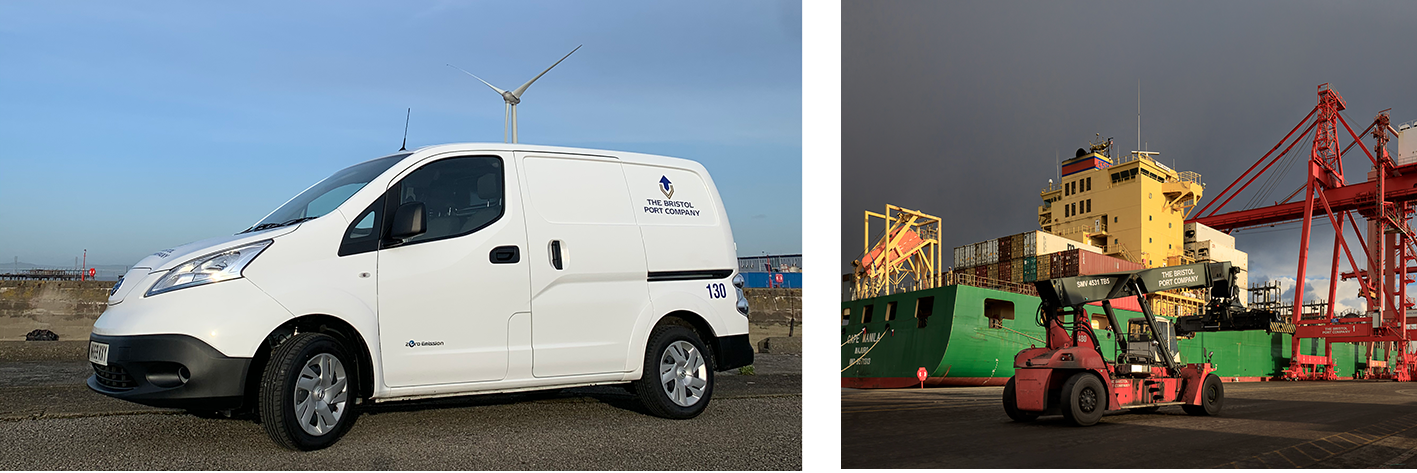
Webfleet has created a unique driver safety solution for The Bristol Port Company to stop unauthorised use of high-risk plant equipment, while helping cut projected fleet emissions by 79.2 tonnes of CO2 a year.
One of the UK’s largest deep-sea multi-modal transport hubs, Bristol Port handles 12 million tonnes of cargo annually across a 2,600-acre estate. Its diverse fleet spans more than 200 cars, LCVs and heavy plant, including container stackers, excavators and Class 5 forklifts.
Webfleet was appointed to create a bespoke driver identification solution to ensure only approved personnel can operate high-risk plant equipment. Before ignition, the platform checks a driver’s access-control keycard against an approved whitelist and the correct, in-date specialist licence – immobilising the vehicle if either check fails.
“The Webfleet team has been highly proactive in tailoring its driver ID platform to the demands of a complex port environment, with hundreds of dockers, plant operators and subcontractors on site daily,” said Bailee Harrison, Engineering Coordinator at The Bristol Port Company.
“Any unlicenced vehicle use could expose us to serious risk of uninsured liability. By integrating all our fleet management and compliance needs onto one platform, we know we can now rely on Webfleet to protect our drivers and our reputation.”
The system also flags every denied access attempt, helping to highlight where further training may be needed.
“It’s free training in ultimately transferable skills, which is a win-win for both the port and the driver,” said Harrison.
Webfleet’s OptiDrive 360 driver behaviour monitoring has already demonstrated a 15.5% improvement in mpg and a 4.7% reduction in idling during a pilot trial across SUVs, with a potential annual saving of £161 per vehicle.
Instant crash alerts, complete with speed, location and g-force data, are enabling accurate fault analysis and identification of on-site risk hotspots.
The solution is also central to the company’s drive towards Net Zero by 2040. All diesel transit vans used as crew buses are set to be replaced with PHEV Ford Transit Kombis by 2030, with the first four hybrids already delivering a 62% improvement in mpg and more than 50% improved fuel efficiency. This equates to a predicted annual fuel saving of £23,000 and an annual CO2 reduction of 79.2 tonnes.
Webfleet’s EV transition tool, using real-world rather than manufacturer-quoted mpg data, is supporting broader electrification planning by providing TCO estimates and charging infrastructure guidance.
Accurate daily fuel usage and CO2 data, meanwhile, enables the Net Zero team to establish a robust carbon baseline and track progress against reduction targets.
“Previously we had to manually analyse individual vehicle records,” added Harrison. “Now we can generate detailed reports showing exact CO2 output by vehicle and across the fleet in seconds.”